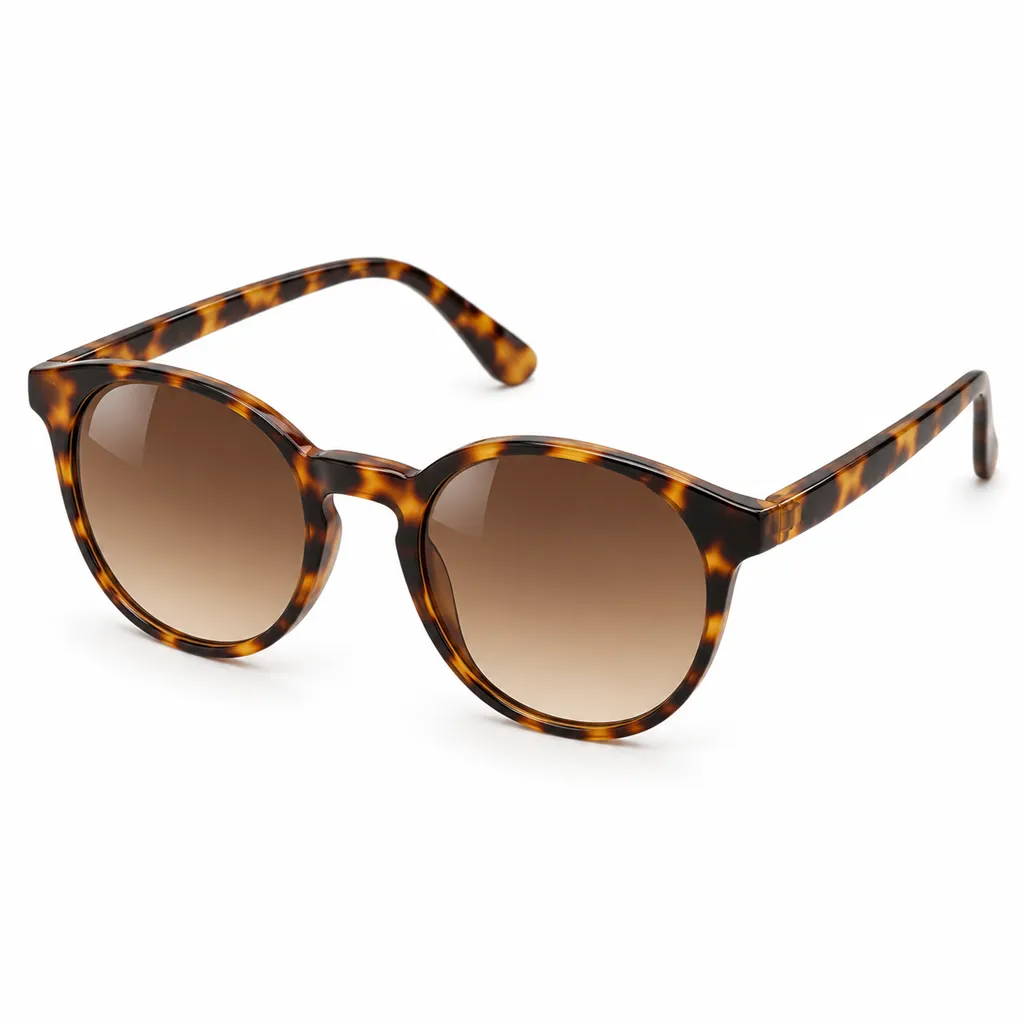
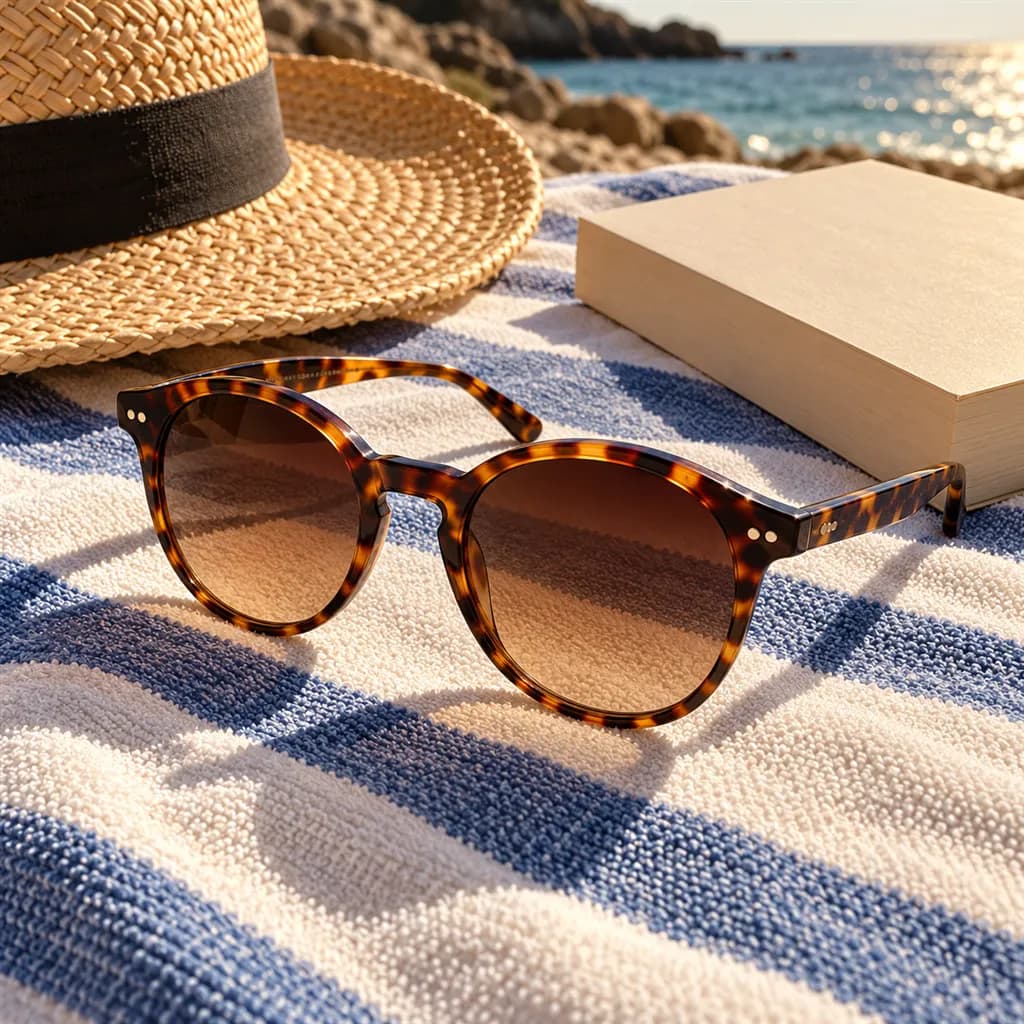
Sunglasses photos have to show the frame shape, the true lens colour and how the pair sits on a face, without the lenses mirroring the room they were shot in. Starting with one photo of the pair, AngleForge renders a three-quarter main image on white, front and side views of the frame, hinge and lens close-ups, and worn or styled scenes for Amazon, Flipkart and Shopify.
Sample images AI-generated from a text description. Yours are made from your own product photo.
Eyewear is a reflection problem before it is anything else. Every lens is a small curved mirror, so a pair photographed on a desk carries a picture of the window, the ceiling light and often the photographer. Tinted, gradient and mirrored lenses change colour with the viewing angle, and a frame that looks neat folded on white can turn out too wide or too narrow once it is on a face.
People buying glasses online want to know two things: what shape is the frame, and will it suit my face? The front view settles shape, the three-quarter view shows how the frame wraps and how thick the temples are, and a worn shot shows proportion. AngleForge keeps the pair as photographed, and reflections in your photo can carry through to every image, so take it facing a plain white wall or sheet with the temples open, then let the tool build each angle and scene around it.
What shoppers check
The questions your photos have to answer
What shape and width is the frame?
A straight-on front view shows the lens outline, the bridge and the overall width at a glance. List the lens, bridge and temple measurements printed inside the arm in your bullets for buyers who compare with a pair they own.
What colour are the lenses really?
Tint shifts with the angle and the background. A neutrally lit image on white shows the true colour, and a three-quarter view shows whether a gradient fades from dark at the top to light at the bottom.
How will they look on me?
A worn lifestyle shot shows how wide the frame sits against a face and where the lenses fall relative to the eyebrows and cheekbones, which is what buyers are trying to picture.
Are the hinges and arms well made?
A close-up of the hinge, whether spring-loaded, riveted or barrel, plus a side view of temple thickness, shows the build quality of a pair that will be folded and unfolded every day.
Does it come with a case?
An image of the pair leaning on its case or pouch shows what arrives in the box, which matters most when the glasses are a gift.
The shot list
Shots that sell sunglasses & eyewear
A set of 8 images includes every shot on this list, because each set uses the angles in order. That is 16 credits at 2 credits an image.
1
Hero
The search thumbnail: the whole pair, temples open, lenses showing nothing but clean highlights.
2
Front
Frame shape, bridge and lens outline straight on; seller guides to Flipkart list a front image as mandatory for accessories.
3
45°
Three-quarter view from slightly above, the main-image angle in Amazon's eyewear style guide and the angled view Flipkart guides call for with sunglasses.
4
Side
Temple profile: arm thickness, the hinge and the curve behind the ear, which separates wraparound sports frames from flat fashion fronts.
5
Top-down
From above, the frame's curvature and both arms at full length, the clearest view of wrap and fit.
6
Detail
Macro of the hinge, the nose pads, the lens edge or a gradient tint, where careful buyers check quality.
7
Lifestyle
Worn or styled in a scene that suits the frame: a beach towel for resort styles, a desk and laptop for blue-light glasses.
6 free credits on sign-up for 3 test images · no card needed
Example brief
“Round tortoiseshell acetate sunglasses with brown gradient lenses, temples open. Keep the lens tint and the metal hinge pins exactly as photographed; bright, even light and no hard reflection across the lenses.”
Styling and light
Control what the lenses see. Photograph the pair facing a white wall, sheet or large card and step out of the line of the lenses, so the only reflection is a clean white highlight.
Open both temples to the same angle in every photo and stop them flaring outward; splayed arms make a frame look wider than it is.
Keep the colour grade neutral. A warm grade turns grey lenses brown and a cool one turns brown lenses grey, and buyers compare tints closely between colourways.
Polish lenses and frames with a microfibre cloth just before the photo and check the nose pads for skin oil, which close-ups pick up.
Marketplace rules
What each marketplace expects
Rules change, so check the current category guide in your seller dashboard before you upload.
Amazon
Amazon's Eyewear style guide asks for the main image to be photographed at a three-quarter view from slightly above, on a pure white background, with one product per image and the entire product shown.
It rules out packaging, brand tags, mannequins and anything that isn't part of the sale, and each lens or frame colour needs its own main image in that colour. The guide dates from 2010–2012, so check the current one in Seller Central.
Fynd's guide to Flipkart's image rules lists front and back images as mandatory for accessories, adds an angled shot for sunglasses, and asks for the case where one is supplied.
The same guide wants a white or light grey background, no props, text or watermarks, and models wearing no other accessory. Photograph the inside of the frame and the case yourself, and check Seller Hub for the current rules.
Shopify attaches one image to each variant and shows it as the preview when a shopper picks that option, so give every lens or frame colour its own clean front or three-quarter image.
Shopify says square product images display best at 2048 × 2048 and that a consistent aspect ratio keeps images the same size on collection pages; the Shopify preset exports at 2048 × 2048.
The photographer, a window or a ring light reflected in the lenses.
Temples folded in the main image, hiding arm length and making the frame look narrower.
A colour cast that changes the lens tint, so the pair arrives looking different from the photos.
One colourway's images reused for every lens colour in the listing.
Worn shots where earrings, a hat or a watch compete with the frame for attention.
FAQ
Sunglasses & eyewear photography questions
How do I stop reflections in sunglasses photos?
Control what the lenses face. Shoot toward a white wall or a large white card, switch off lamps in front of the pair and stand to one side of the lens line. AngleForge keeps the pair as photographed, so a reflection in your photo can carry into every image in the set.
Should sunglasses be shown with the temples open or folded?
Open, at the same angle in every shot, for the main image and most of the set: it shows arm length and frame width the way the pair sits on a face. A folded pair suits a later image with the case or a flat lay.
Which angle should be the Amazon main image?
Amazon's Eyewear style guide asks for a three-quarter view from slightly above, which matches the 45° shot. Export it with the Amazon preset for a 2000 × 2000 JPEG on pure white, and use the front, side and worn shots in the other slots. The guide is an older edition, so check the current one.
Can AI put the sunglasses on a face?
The Lifestyle shot places the pair in context, worn or styled, and you can describe the scene you want in your brief. Check that the frame width looks believable on the face and that the tint matches your photo, and keep worn shots out of the Amazon main image.
What does a sunglasses set cost?
At 2 credits per image, the 8-image set that covers every shot here costs 16 credits. A new account includes 6 free credits for 3 test images; after that, packs start at $12 for 30 credits, and you can download and export every image free.
Sign up, upload a photo and your first image is ready in about 30 seconds. Make 3 images free, then pick a pack or plan. Your first credit pack comes with 50% extra credits.